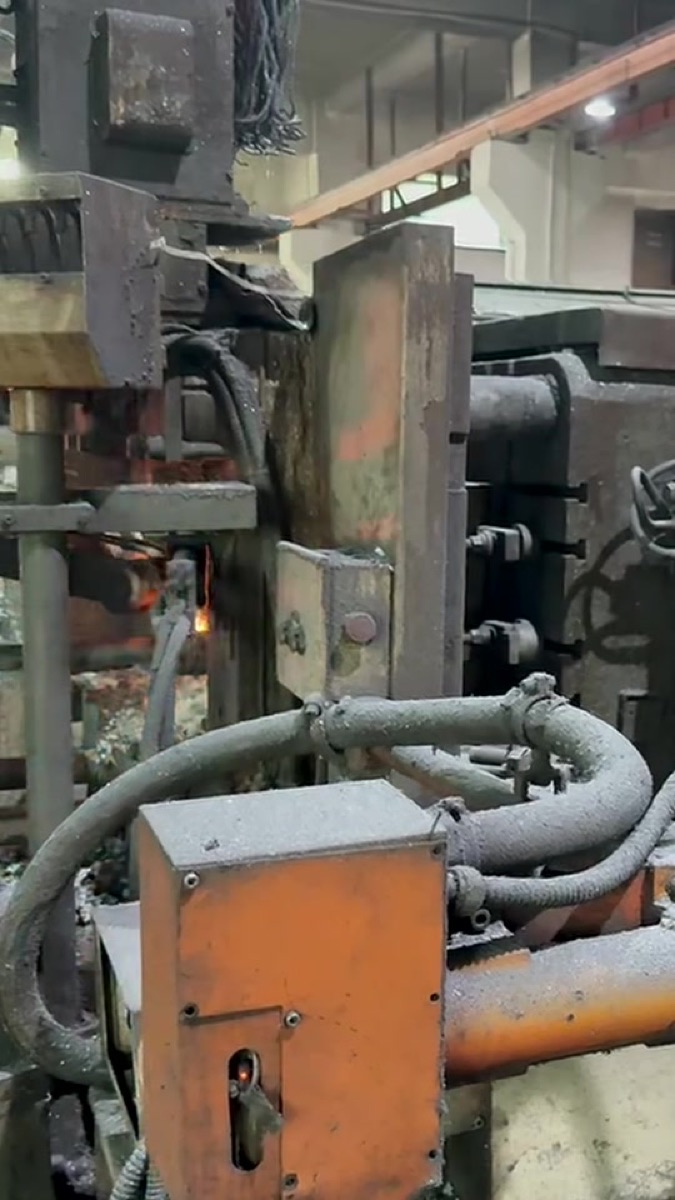
A Chinese factory refused to start my client's $38,000 tool order.
It was the best thing that happened to his product all year.
He had sent a die-cast enclosure design — approved internally, signed off, ready to cut steel. Most factories would have taken the deposit and started machining that afternoon.
This one didn't. Their engineer called first.
"This wall is 0.8mm right next to a 4mm boss. On our machine, at production speed, that thin section won't fill consistently. You'll get short shots. Can we add a rib, or take it to 1.5?"
Nobody on his team had caught it. Not the industrial designer. Not the DFM review. Not me, on the first pass — honestly.
One question, before a single chip was cut, saved him:
- a re-cut tool ($38,000)
- a scrapped first run
- eight weeks he didn't have
Why 0.8mm next to 4mm is a problem
The dimension itself isn't the villain. Plenty of die castings have 0.8mm features. The problem is the transition.
Molten aluminum enters a die at roughly 700°C and fills the cavity in well under a second. The die is cold relative to the metal — deliberately, because that's what freezes the part fast enough to run a production cycle. Everything about the process is a race between filling and solidifying.
Put a thin section next to a much thicker one and you lose that race in two directions at the same time:
The thin wall starves. Metal moving into a 0.8mm channel loses heat to the die faster than metal moving through a 4mm one. If it starts to freeze mid-fill, you get a short shot — the section simply doesn't fill — or a cold shut, where two flow fronts meet after both have cooled too far to fuse. A cold shut looks like a hairline seam. It behaves like a crack.
The thick boss shrinks. A 4mm boss stays molten longer than everything around it. As it finally solidifies it contracts, and it pulls whatever is still liquid toward itself. That's where shrinkage porosity concentrates — often invisible from the outside, right up until the part is machined, pressure tested, or loaded in service.
Both failures are geometry decisions, not process decisions. No amount of parameter tuning on the machine fixes a wall the metal can't reliably reach.
What "in spec" doesn't tell you
Here's what makes this failure mode so expensive: the drawing was correct. Every dimension was achievable in isolation. A CAD model with a 0.8mm wall next to a 4mm boss opens, renders and passes every check you can run on a screen.
As one industrial designer put it in a discussion of this case: a 0.8mm wall next to a 4mm boss looks like a small geometric detail — but at production speed it becomes a process decision.
That's the whole gap in one sentence. That wall doesn't fail in SolidWorks. It fails at 400 shots per hour on a cold die at 3am.
Working ranges for aluminum die casting walls
| ADC12 wall | Verdict | In practice |
|---|---|---|
| Under 1.0 mm | A conversation, not a dimension | May be possible on the right gate, machine and alloy — but that is a different claim |
| 1.5 – 3.0 mm | Normal production range | Where most consumer and industrial enclosures sit |
| 2.0 – 2.5 mm | Common for a housing | The default to start from unless something forces otherwise |
The absolute number matters less than three habits:
- Keep it uniform. A part with consistent 2.2mm walls is easier to cast well than a part that ranges from 1.2mm to 4mm, even if every individual dimension is "castable."
- Transition gradually. Where thickness has to change, ramp it. An abrupt step is where flow fronts and shrinkage both misbehave.
- Keep bosses and ribs thinner than the wall they meet. A boss that's thicker than its surrounding wall becomes a shrinkage sink and often a visible sink mark on the show surface.
"Possible" and "reliable at 30,000 parts" are different claims.
Anything under about 1mm should be treated as a conversation with the caster, not a dimension you assume. It may well be possible — on the right gate location, the right machine, the right alloy. "Possible" and "reliable at 30,000 parts" are different claims.
The real lesson isn't about walls
Most founders get this backwards: the cheapest factory takes your order. The best factory questions it.
A quote that comes back in an hour with zero questions isn't fast. It's a factory that will build exactly what you drew — mistakes included — and invoice before the problems show up.
The one you want is the one that emails back: "Why is this wall so thin?"
And that factory isn't doing you a favour. It's protecting its own yield. A short-shot batch costs the caster money too — in scrap, in machine hours, in the argument that follows. When a factory raises a design concern before cutting steel, its interests and yours are pointing the same direction. That alignment is worth more than a 10% price advantage from a supplier who just executes.
The question that separates the two
Before you place an order with a factory you haven't worked with, ask one question:
"What DFM issues do you see in this design?"
A factory that has actually reviewed your files will name something specific — a wall that's too thin, a feature that will trap air, a draft angle that will cause ejection problems, a parting line running through a cosmetic face.
A factory that just wants the order will say: "Design looks fine, no issues."
On a first-pass die casting review, "no issues" is almost always wrong. Either they didn't look, or they're telling you what you want to hear. Neither is a good start to a relationship where you're about to wire a deposit.
One question. Thirty seconds. It tells you more than the entire quote sheet.
Why this knowledge is missing, not rare
None of this is exotic. Tooling engineers and casters have known it for decades. A machinist who came up through a shop floor would call it basic.
The gap isn't that the knowledge is rare. It's that it's absent from the room where most hardware startups make the decision.
A founder has an idea and a CAD file. Maybe they hire a contract designer — often a generalist, not a mechanical engineer. The model looks correct. Then it goes out for quotes, and a good factory builds exactly what was drawn.
The person who knew to ask the question wasn't in the room, and nobody knew to invite them.
Twenty years ago that person often was in the room — companies kept tooling engineers in-house and brought them into design reviews. Offshoring quietly removed them from the review without anyone deciding to. Now that knowledge sits twelve time zones away, available only after a drawing is submitted.
Which is why the factory in this story mattered so much. It was doing, at the quoting stage, what an in-house tooling engineer would have done at the design stage. Later than ideal — but still early enough to save $38,000.
What to do before you send your next RFQ
You don't need to learn die casting. You need someone who has actually made the part to look at the drawing before it's released — a caster, a tooling engineer, or your factory, if they'll do it honestly.
The five checks I run before any founder sends money to a factory in China are written up in the free China Manufacturing Starter Kit — factory screening questions, how to read a mold quote, the tolerances that only fail in the field, supplier due diligence, and the contract clause that keeps the tool yours.
If you'd rather just put your actual drawing in front of someone: the first 15-minute call is free. Bring the part. I'll tell you what I'd flag.