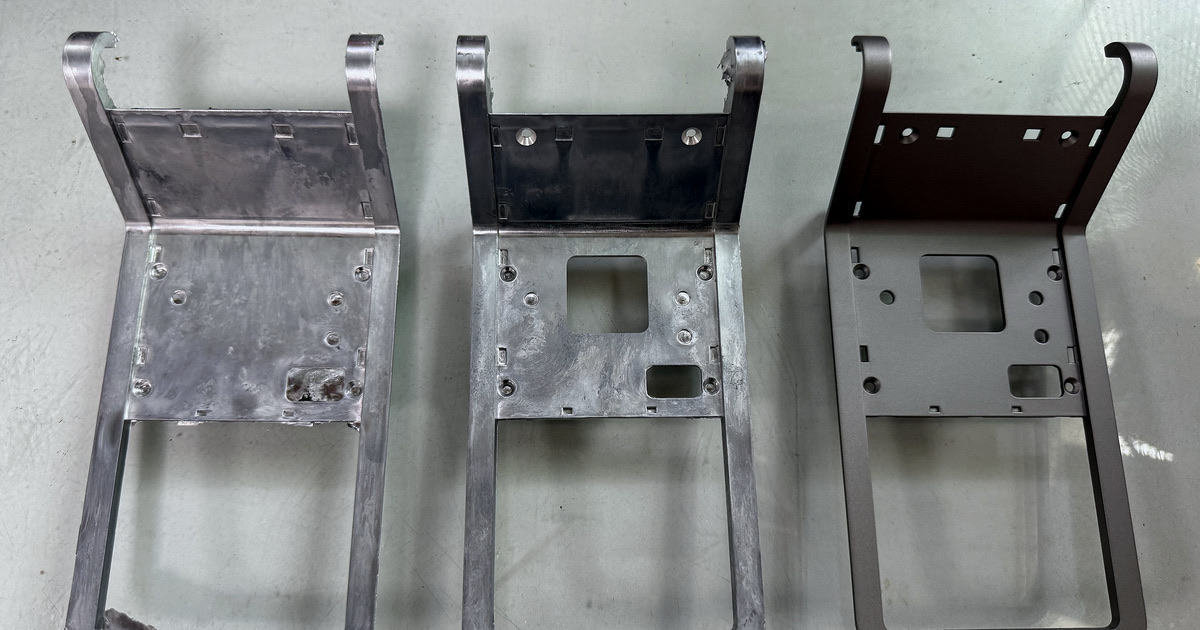
Nobody tells hardware founders about draft angles.
Then a mold quote comes back with a $12,000 "design revision" line item and no explanation of what it's for.
This is one of the most common surprise costs in a first tooling project, and one of the cheapest to avoid — if someone tells you about it before the quote instead of after.
What draft angle actually is
Draft is a slight taper on any surface that runs parallel to the direction the tool opens, so the part can let go of the steel.
A molded or cast part shrinks as it cools. It shrinks onto the core it was formed around. If the walls of that core are perfectly vertical, the part grips it like a cork in a bottle. Ejecting it then takes real force — and force is delivered through ejector pins pushing on a part that is still warm and soft.
You see the consequences as: drag marks and scuffing down the side walls, whitened or stressed regions around ejector pins, distortion on thin sections, occasional cracking, and parts that stick in the tool and stop the cycle.
Draft is not a cosmetic refinement. It's a condition for the part coming out at all.
0°, 1°, 3° — three different products
0° (no draft). Viable only on surfaces perpendicular to the pull, or where the tool has a specific action designed to release that face. On a normal side wall it means high ejection force, marked parts, faster tool wear and a cycle time you pay for on every single shot for the life of the program.
1° per side. The usual working minimum for a smooth surface. Parts release cleanly, ejection force drops, cycle time stabilises. On most enclosures the visual difference is imperceptible; on a 40mm-tall wall, 1° moves the top edge by about 0.7mm.
3° per side. Standard territory for deep draws, tall ribs and long cores — the geometry where the grip is strongest and the ejection distance longest. It's also where founders push back hardest, because 3° on a tall wall is visible in the CAD model.
A useful way to hold it: 1° to 2° suits most smooth surfaces. Deep features want 2° to 3° or more. Textured surfaces want more still — as a rough guide, roughly 1° to 1.5° of extra draft for every 0.025mm of texture depth, because texture is thousands of tiny undercuts that all have to release at once.
Those are working guides, not standards. The number that matters is the one your toolmaker confirms against your actual geometry, texture and material.
Why it's cheap in CAD and expensive in steel
Adding draft to a model is a feature edit. It takes an engineer minutes.
Adding draft after the tool has been designed — or worse, cut — is a different job entirely:
- Cavity and core steel has to be re-machined, and possibly re-polished or re-textured.
- Parting lines and shut-off faces need re-checking, because the taper moved them.
- Wall thickness has to be re-verified, because draft adds material in one direction and removes it in the other — a 2mm wall with 3° of draft over 30mm is no longer 2mm at both ends.
- Anything dimensioned to the old surfaces — fixtures, mating parts, gaskets, assembly jigs — has to be re-checked too.
That's what the "design revision" line item is buying. It isn't a markup. It's the engineering hours to make an untoolable model toolable, priced before it becomes a re-cut instead of after.
And note what it tells you about the supplier: a factory that quotes a design revision has actually opened your model. A factory that returns a clean price with no comment may simply not have looked.
The question to ask when you see that line
Don't negotiate the number first. Ask what's in it:
"Can you itemise the design revision — which features, and what change are you proposing for each?"
A supplier who has done the review will answer specifically: these four bosses have no draft, this rib is 0.9mm and won't fill, this undercut needs a side action, the parting line runs through the cosmetic face.
Three things come out of that answer. You learn what's actually wrong with your design. You find out how carefully this supplier reviews. And you can decide which changes to make yourself before re-quoting — which is usually cheaper than paying an engineering line item for them.
Specify draft before you get quoted
The whole problem disappears upstream. Before an RFQ goes out:
- Apply draft in CAD, not in the notes. A drawing note saying "add draft as required" pushes the decision to someone who doesn't know which surfaces are cosmetic.
- Mark the pull direction. Draft only means something relative to how the tool opens. State it.
- Say which faces are cosmetic. That's the trade-off conversation — where you'd rather accept more draft than a witness line.
- Flag texture early. Texture depth drives extra draft, and it's routinely specified after the tool is cut, which is exactly when it hurts.
- Ask the caster or moulder before you freeze geometry. Twenty minutes with someone who has made the part is worth more than any tolerance standard you'll read.
The pattern underneath
Draft angle is one instance of a much larger pattern: the decisions that dominate manufacturing cost are made early, by people who don't yet know they're making them.
By the time a drawing reaches a supplier for quoting, the geometry is frozen, the material is locked, and the easy changes are gone. DFM at the concept stage costs an hour. DFM after tooling starts costs a re-cut.
Nobody's at fault in the usual sense. The founder didn't know draft existed. The contract designer modelled what was asked for. The factory quoted what it received. The knowledge that would have prevented it sits with tooling engineers and casters — who, on most hardware startups, don't see the drawing until after it's released.
Before your next RFQ
The five checks I run before any founder sends money to a factory in China are in the free China Manufacturing Starter Kit — factory screening questions, how to read a mold quote line by line, the tolerances that only fail in the field, supplier due diligence, and the contract clause that keeps the tool yours.
Or bring the actual model to a free 15-minute call and I'll tell you what a toolmaker will flag — before it becomes a line item.